

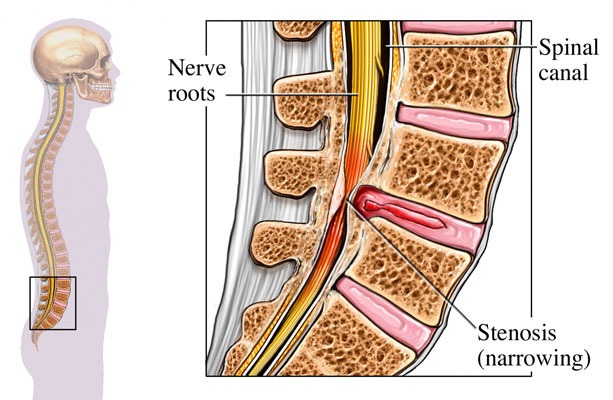
What does spinal canal stenosis mean?
It is the compression of the spinal cord or nerve roots due to narrowing of the spinal canal. When spinal cord injury develops, it is called myelopathy; when the damage becomes visible on MRI, it is termed myelomalacia.
Who is more commonly affected?
More common at older ages, especially in:
• Cervical (neck)
• Lumbar (lower back) regions
With aging, disc dehydration, facet joint enlargement, and ligament thickening increase the degree of narrowing.
What are the symptoms?
- Neck / back / low back pain
- Loss of fine motor skills in the hands (e.g., difficulty buttoning)
- Leg pain and stiffness increasing with walking (neurogenic claudication)
- Relief when bending forward
- Bladder–bowel control problems or sexual dysfunction (in advanced cases)
How is canal stenosis evaluated?
• Neurological examination
• MRI imaging (level of narrowing and spinal cord involvement)
• Timely treatment planning if findings are progressive
“When permanent spinal cord damage develops, there is no proven treatment that can reverse it. Therefore, early diagnosis is critical.”
Can canal stenosis improve?
The main problem is mechanical pressure on the spinal cord or nerve roots. In suitable patients, surgical removal of the pressure may lead to reduction or stabilization of symptoms.
In the literature, with correct surgical indication, approximately 60–80% of patients show significant improvement in pain and walking capacity. Outcomes vary depending on disease duration, presence of permanent cord damage (myelomalacia), and accompanying illnesses.
What happens if surgery is delayed?
If the spinal cord remains compressed for a long time, irreversible nerve damage may occur. In such cases, surgery may stop progression, but lost functions may not fully return.
How is canal stenosis treated?
Answer (stepwise approach):
- Clinical and MRI evaluation
- If there are no advanced neurological deficits: close follow-up and symptom control
- If there is progressive weakness, gait disturbance, or bladder–bowel dysfunction: evaluation for surgical decompression
Can canal stenosis be treated without surgery?
Current scientific evidence shows there is no non-surgical method that permanently enlarges the spinal canal. Non-surgical approaches may temporarily reduce symptoms in some patients but do not eliminate the underlying compression.